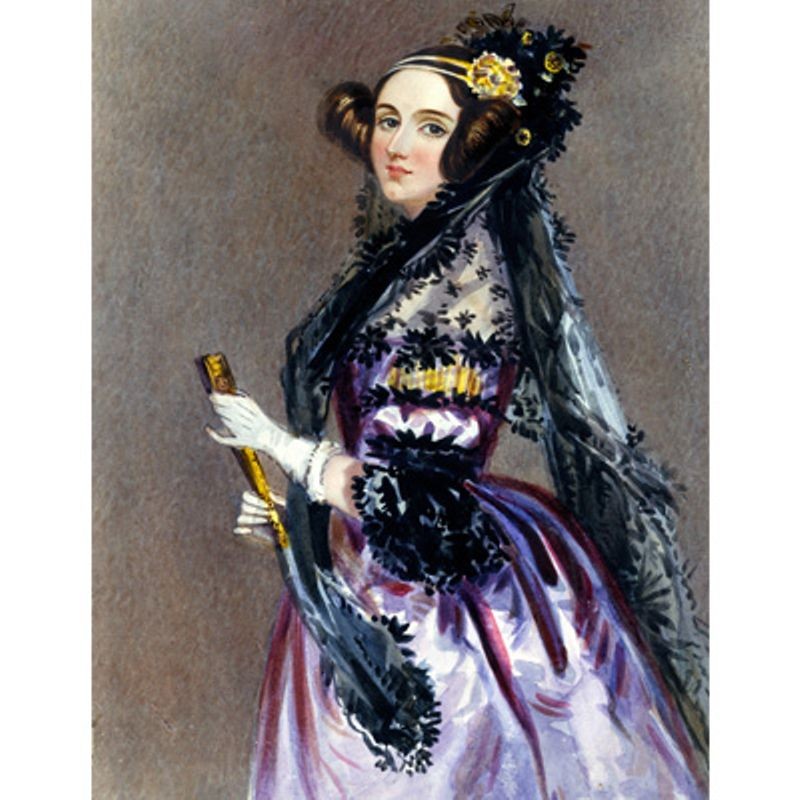
The First Computer Programmer


Ada Lovelace

Play as audio:


Here's a lesser known fact I wished to share with you and what better day than today. Why? Read on to find out.
Have you ever thought about the first programmer ever?

Ada Lovelace was born to the renowned poet Lord Byron and Annabella Milbanke Byron. Their marriage didn't last long and Ada parted from her father at a very young age. To get rid of the 'fatal' mental tendencies of Ada's father, her mother emphasized arts like music, French, and the cognitive study of mathematics on Ada. The last one fascinated the young girl.

In 1833, Ada met the mathematician Chalres Babbage. Yes, the Charles Babbage who is considered "father of the computer". He had deveoloped a design for a machine with similar functions to a calculator and named it the 'Difference Engine'. Ada was motivated and felt very inspired with this revolutionary machine. She became Babbage's friend for life.

He had an ideation of a new project, a much more complex and modernized one- the Analytical Engine. In 1843, Ada translated a French paper that Luigi Menabrea (an Italian  mathematician) had written about the above project. She even added her own notes to the renewed papers. She noticed that the new machine could carry out slightly more complicated mathematical operations. One example she mentioned was how to calculate Bernoulli numbers- this is now recognized by many as the first computer program ever written. She analysed that the Analytical Engine could carry out operations on "other things besides numbers", like musical notes.

Unfortunately, only a fragment of the Analytical Engine was built when Ada Lovelace died in 1852. Her effort however, was awarded as she passed on her name to the Ada Programming Language . Annually, the second tuesday of October is now celebrated as Ada Lovelace Day to appreciate women's contribution to STEM(Science Technology Engineering Mathematics).
Share with others to help them recognize her efforts too.

Happy Women's Day:)

Popular posts from this blog

Empowering Education: The Impact of Technology in the Classroom

  Play as audio: Coming soon..... Technology has transformed various aspects of our lives, and one area where its impact is particularly profound is education. In recent years, technology has revolutionized the way students learn and teachers teach in the classroom. In this blog, I will explore the positive impact of technology in education and how it empowers students and educators alike. 1. Access to Information: Technology has made access to information easier and more convenient than ever before. With the internet, students can research and explore a vast array of educational resources, articles, videos, and online libraries. This instant access to information allows students to delve deeper into subjects and expand their knowledge beyond traditional textbooks. 2. Interactive Learning: Technology has transformed the learning experience by introducing interactive tools and platforms. Digital simulations, educational apps, and online learning platforms engage students in hands-on...

Ethical AI: Striking a Balance Between Innovation and Responsibility

  Play as audio: Coming soon..... Artificial Intelligence (AI) has rapidly advanced in recent years, offering tremendous opportunities for innovation and transformation across various industries. However, as AI becomes more integrated into our daily lives, it is crucial to address the ethical implications that arise from its use. In this blog, I will explore the concept of ethical AI, the importance of responsible AI development, and the need to strike a balance between innovation and ethical considerations. 1. Understanding Ethical AI: Ethical AI refers to the development and deployment of AI systems that align with ethical principles and values. It involves ensuring that AI algorithms and systems are designed to respect human rights, fairness, transparency, and accountability. Ethical AI aims to mitigate potential biases, discrimination, privacy concerns, and negative social impacts that can arise from the use of AI technology. 2. Fairness and Bias Mitigation: One of the key ethi...

Unleashing Creativity: Exploring the Intersection of AI and Art

  Play as audio: Coming soon..... Artificial Intelligence (AI) has transcended its traditional role in automation and data analysis to become an unlikely collaborator in the realm of art. By blending human creativity with AI's computational power, artists and technologists are unlocking new possibilities and pushing the boundaries of artistic expression. In this blog, we will dive into the intersection of AI and art, examining how this fusion is revolutionizing the creative process and inspiring new forms of artistic exploration. 1. AI as a Creative Tool: AI algorithms can generate, analyze, and interpret vast amounts of data, making them valuable tools for artists seeking to explore new creative avenues. Artists are harnessing AI to assist in the creation of visual art, music, poetry, and even storytelling. AI algorithms can generate unique visual patterns, compose music, or create innovative narratives, offering artists new sources of inspiration and expanding the realm of artist...